
You Have to Love It First: Aaron Haiman on birds, science communication, and the gap between people who study nature and the people trying to teach it
When I was a kid, the adult I most wanted to grow up to be wasn't a doctor or an astronaut. He was my outdoor educator — a guy who'd been a dog-sledding instructor in Canada, sailed around the world, led kayaking trips across Southeast Asia. I didn't want his job. I wanted his lifestyle.

Aaron Haiman had a version of that same moment, just with birds instead of boats.
He was maybe six years old, wandering the East Bay Hills near his house, when he met an ornithologist — the director of a bird migration research center in the Marin Headlands. That was it. "That's a cool path," Aaron remembers thinking. "I could do that too." Twenty-some years later, Aaron is a birder, naturalist, environmental scientist with the California Wildlife Conservation Board, and the author of a brand new book, Birds of the California Delta.

He told me something early in our conversation that I haven't stopped turning over since. It's not his idea
originally — plenty of people have said versions of it before him — but he's built an entire career on top of it:
"Humans are really much more likely to save things that we love, and we will love things that we understand."
Loving something, in other words, isn't the finish line of conservation work. It's the entry point.
I told Aaron about a version of this I stumbled into by accident. I used to teach elementary school, and I had a whole toolkit of outdoor games designed to teach ecology through metaphor. One day I was walking a class across a four-way stop toward the park — cones set up, activities planned — and every kid in line stopped dead, transfixed by a trail of ants. I remember being furious. I'd planned all of this, and they were staring at bugs on the sidewalk.
And then, mid-fury, I realized I had it backwards. They weren't ignoring me. They were doing exactly what Aaron's whole career is built on — being curious about something small and real and right in front of them. I was the one asking them to ignore it.

Aaron found his version of this same disconnect from the other direction. In grad school at UC Davis, he noticed that bird scientists and birders — people who study birds and people who watch birds obsessively for fun — almost never talked to each other. Researchers cared about the research question; the species was almost incidental. Birders knew everything about where to find a bird and almost nothing about the research coming out of the lab down the road. Two communities that should have been one. Aaron complained about this so often that his wife and brother told him, separately, to stop complaining and start writing. So in April 2012, he started a blog called A Birding Naturalist. He's still writing it, thirteen years later.
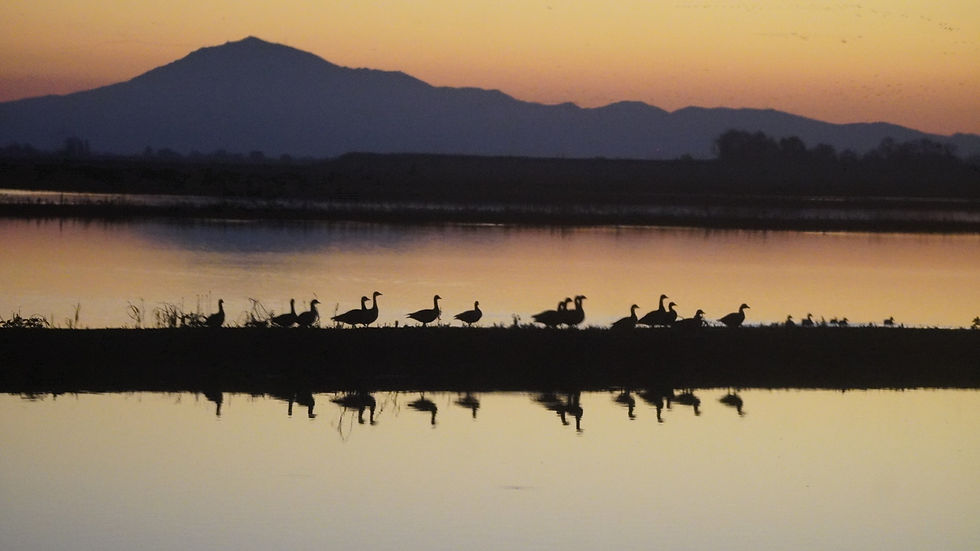
His new book takes the same bridge-building instinct and applies it to a place. Birds of the California Delta profiles 25 species that tell the story of California's Sacramento–San Joaquin Delta — not through the flat, stereotypical profile-view illustrations you'd find in a standard field guide, but through illustrator Martha Espinosa's work showing birds in their actual lives, doing actual things. "I had to remember, and relearn, several times," Aaron told me, "where the reader is starting from, and what they might actually be curious about."
That instinct — meeting people where they already are — is also, it turns out, the whole

strategy behind his YouTube channel. Aaron told me the videos that connect aren't the ones about esoteric evolutionary biology. They're the ones about garden snails. Something everyone's already seen crossing their own sidewalk. He's not being modest about this; he told me it made him feel a little dumb that it took him this long to notice.
Aaron also runs the longest continuously operating youth bird-a-thon team in the country — the Drake's Beach Sanderlings, now in its 26th year, raising money for Point Blue Conservation Science one frantic 24-hour birding sprint at a time.

None of this work has happened in a vacuum this year. A January 2025 federal memorandum specifically targeted California water policy, floating the idea that releasing dam water into Central Valley rivers could somehow help fight fires in Southern California — a claim that falls apart the moment you understand these are entirely different watersheds. Aaron's own program at the Wildlife Conservation Board sits downstream of that kind of attention. So does the Wallace Annenberg Wildlife Crossing over Highway 101 — one of the largest wildlife crossings in the world, built to reconnect two mountain ranges an eight-lane highway split apart, and recently mocked publicly by people who apparently didn't understand that reconnecting two mountain ranges was, in fact, the entire point.
"It's like you saw the point," Aaron told me, "ran smack into it, and still somehow managed to miss it."

He takes the same kind of heat, more personally, for a different reason. Every June, Aaron puts out a video explaining that homosexuality and other LGBTQIA+ identities occur naturally and widely throughout the animal kingdom. He's not a member of that community himself, and he's deliberate about saying so — pointing people toward voices who are, sticking closely to the biology and the data, trying not to come across as a savior for a fight that isn't his to lead.
"If I can step into the crosshairs and take some of that heat from other groups," he told me, "I'm perfectly happy to. It costs me nothing."
I asked Aaron what he'd want someone listening to this to actually go do. His answer wasn't complicated. Look at your own yard. Your own street. Your own neighborhood. Find the one small thing — a cleanup, a little less meat, biking somewhere you'd normally drive — and do that. Not because one action solves climate change or habitat loss on its own, but because loving a place starts small, close to home, with something you can actually understand.
Listen to this week's episode of Hopeful by Nature wherever you get your podcasts.
— Scott
Wildward Institute supports organizations, educators, and parents building meaningful relationships between young people and the outdoors. Learn more at wildwardinstitute.net.
Resources mentioned in this episode:
A Birding Naturalist — https://www.youtube.com/@ABirdingNaturalist ·
Birds of the California Delta (Heyday Books) — https://www.heydaybooks.com/catalog/birds-of-the-california-delta/
Drake's Beach Sanderlings / Point Blue Conservation Science — pointblue.org
Subscribe to Hopeful by Nature to get the next story in your inbox.


Comments