
Asking Better Questions: Matt Baker-White on Grappling with Complexity Outdoors
Matt Baker-White on teaching college students to take on problems that adapt to whatever you do to them, and why the best outcome of a course might be better questions instead of answers.

I left home at sixteen to sail around the world on a tall ship. I climbed the mast, set and doused sails, and learned to find our position on the open ocean with a sextant. We stepped onto isolated islands where I tried new food, heard new languages, and learned history no classroom had taught me. It was a significant life event, and it opened my eyes to how unequal access to experiences like that really is. I've spent my career working on that part.
What I couldn't have told you at sixteen is that a trip like that doesn't just hand you answers. It changes which questions you know to ask.

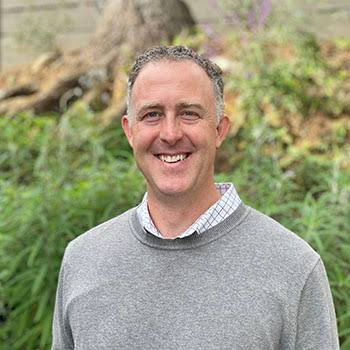
Matt Baker-White builds those experiences for college students. He's the executive director of the Wild Rockies Field Institute (WRFI) in Missoula, Montana, which teaches accredited college courses outdoors, in environmental studies, geography, Native American studies, philosophy, studio art and climate change. He started as an outing club trip leader and a volunteer search and rescue team member, became a climbing instructor, and taught K–6 in a single-room school in rural Maine before landing in Montana.
The story that stayed with me comes from a course called Cycle the Rockies. Students ride touring bikes from Billings to Glacier National Park, about 630 miles, asking two questions: how do we make and use electricity in Montana, and what does that mean for climate change? Along the way they visit wind farms and solar arrays and sit down with ranchers, activists and coal miners.
One student arrived on day one certain that the solution was to stop all extractive industry tomorrow. Partway through the course, the group stopped at a gas station in a small Montana town, and a member of the town council invited them to a public meeting that night about a proposed wind farm that would replace the local coal mine. The townspeople said they believed in climate change. They wanted the jobs and the new school building the company had promised. They also pointed out that nobody in town could repair the circuits at the top of a tower or a carbon fiber blade, and asked whether there was a plan to train them. Matt says the company's answer was a non-answer.
On the last day, that same student stood up to present.
"I came into this course thinking that I knew the answers for climate change and how to solve the energy crisis, and I'm leaving this course feeling like I have no idea what the answers are, but I feel like I'm starting to ask some of the right questions." – a WRFI student, as told by Matt Baker-White

Matt told me that's the point. If a course gets students asking questions they didn't know needed asking, he said, that's the best way to prepare the next generation to grapple with complexity.
"If climate change was a simple problem, we would have solved it. If energy and electricity was a simple problem, we would have solved it." – Matt Baker-White

Here's the moment that stopped me. Matt asked if I knew the difference between technical and adaptive problems. At the Monterey Bay Aquarium, our managers meetings were split into technical meetings and adaptive meetings, and they overlapped constantly because the two are so hard to separate. Matt's version made the difference land. Changing your oil is a technical problem. Once it's done, the problem is gone, at least for a while. Climate change is not.
"Adaptive challenges are the ones that will wriggle away from us if we don't keep on focusing on them." – Matt Baker-White
Move the scaffolds around an adaptive problem and it works around you in a different way. Solve one piece and a new problem can emerge from the solution. That's why he wants students grappling instead of memorizing.
We also talked about access, which is where I always end up. Matt told me about parents in Albuquerque's South Valley who looked at a four-day backpacking trip and said that's not school. I told him about a young man I worked with who came to the United States from Somalia by way of a refugee camp in Kenya. His parents said "camping is for white people," because they had lived in tents as refugees and didn't need to anymore. Regardless, he did continue with us through a leadership development program, and he was later awarded the Gates Millennium Scholarship. The person who announced it said his outdoor leadership experience set him apart from other applicants. Matt's answer at WRFI starts with scholarships, a partnership with HBCU Outside, and cohorted scholarship programs so that no student is alone on a course.

His advice for aspiring outdoor leaders contradicts itself on purpose. First: buy a beat-up Toyota, move to Utah for three to six years, and spend as much time outside as you can, because he wants to hire guides who have enough experience outdoors to have made mistakes and found their limitations. Second: take financial accounting and learn to read a profit and loss statement, a balance sheet and a 990.
"You can have all the passion in the world and be the best educator in the world. And if you can't figure out how to make the finances of a project work, it's very hard to have the impact you want to have." – Matt Baker-White
Matt closed with something you can do this week with no budget. Before you advocate for the public places you love, learn their land histories, including how Indigenous people were removed from the places that are now public lands. Then decide how you want those places left for the next generation. Pick one park, trail or beach you love and find out whose land it was before it was public.

Listen to this week's episode of Hopeful by Nature wherever you get your podcasts.
— Scott
Wildward Institute supports organizations, educators, and parents building meaningful relationships between young people and the outdoors. Learn more at wildwardinstitute.net.
Resources mentioned in this episode: Wild Rockies Field Institute · Cycle the Rockies · HBCU Outside
Subscribe to Hopeful by Nature to get the next story in your inbox.


Comments