
It Starts With One -- What two Australian water scientists taught me about the beach I grew up on
The beach where I learned to surf is closed.
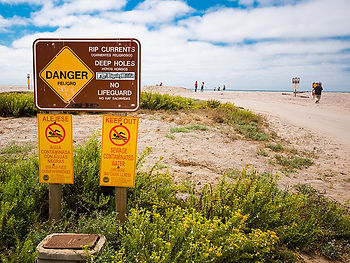
Not occasionally. Not seasonally. Up to three hundred days a year, Imperial Beach — the southwestern-most beach community in the United States, four miles from the Mexican border — is posted with signs that say the water is unsafe for swimming. The waves are still there. The sand is still there. The people who grew up on that beach, who learned to read the ocean there, who felt the Pacific for the first time in that water — they are still there.
But the water is not safe.

Decades of untreated sewage flowing north from Tijuana through the Tijuana River and into the Pacific Ocean have turned one of the best surf breaks in San Diego County into a public health crisis. Since October 2023 alone, an estimated 31 billion gallons of raw sewage, polluted stormwater, and trash have flowed down the Tijuana River into the Pacific. The US and Mexican governments have made pledges. They have not made progress.
I've been thinking about that beach since I sat down with Dr Annette Davison and Sarah Loder

Annette and Sarah are water risk management specialists based in Sydney, Australia. Between them they have several decades of experience protecting communities from contaminated water — drinking water, recreational water, storm water, recycled water, the whole cycle. Annette is a microbiologist and award-winning risk manager who has guided organizations globally in building water safety plans. Sarah is a process engineer and risk specialist with eighteen years of experience across government and private sector clients.
They are also the founders of Water's Most Unwanted — a social media project that turns water contaminants into Western-style wanted posters, complete with danger scores and rogues galleries. And One Street, One Creek — a grassroots community organizing framework built on the belief that you can save a creek one stretch at a time, if you can first get a street to say hello to each other.

I did not expect water scientists to be the people who explained community organizing to me.
The conversation that built One Street started with despondence.
A new prime minister came into office in Australia. Annette felt, as she put it, like the environment had gone to hell in a handbasket. She laid down for a while. And got back up.
"What if we can't rely on government anymore? What have we got to do is rely on ourselves."
So she started with her street. A welcome letter to new neighbors. Information about where the buses run, where the good sourdough is, when the bins are collected. Small things. Ordinary things. The kinds of things that make a person feel like they belong somewhere rather than just living there.

Once a street knows each other, Annette reasoned, it can do something together. In her case: Rocky Creek. The creek that runs behind her house. She got a group together and asked a simple question: what if we improve this one stretch? What if the people who live along this stretch love it, and the people along the next stretch love theirs, and you just keep going until one whole creek is cared for?
"If you can then do stretches and build community connections through the stretches," she told me, "all of a sudden you can get one creek covered in terms of it being loved and cared for."
Sarah put it more plainly: "The engineering side is the easy part. It's really that community engagement and storytelling that is key."
She and Annette also belong to something called the Foodie Group — a group of women from the water and science industry who have been gathering for dinner every six weeks for over eleven years. One person chooses the theme. One person brings nibbles. Someone brings wine. The rest show up to eat and drink.

They have supported each other through relationship breakups, deaths, three of Sarah's children being born. Annette described it, without hesitation, as life-saving.
"When it really can help to lift you out of depression," she said, "knowing that you have a purpose and you don't want to let people down."
I think about the Tijuana River when I hear that. I think about what it would take for the communities on both sides of that border — the surfers in Imperial Beach, the families in Tijuana — to stop asking who is to blame and start asking what they can build together. What it would take to form a community around a shared waterway the way Annette formed one around Rocky Creek. What the welcome letter to that conversation would even say.
Annette and Sarah's closing advice was not what I expected from two water scientists.
Annette: "Just keep your eyes open. See if there's something in your neighborhood you'd like to improve. Even if it's just saying hello to a neighbor you haven't spoken to before."

Sarah: "Use all your senses. Get outside and smell and look and listen. And then stop your kids when you're walking down the street and say — hey, look at that bird. Look what they're doing."
I've been to a lot of lectures about saving the environment. I've never heard one that started with sourdough directions and ended with a lizard basking in the sun.
But the more I sit with this conversation, the more I think that's exactly right. The science tells us what's broken. Community is the technology that fixes it.
The beach I grew up on is still there. So is the creek behind Annette's house. So is the problem. So is the first step.
You can find Annette and Sarah's work at: watersmostunwanted.com — and on Instagram at @WatersMostUnwanted onestreet.earth — free resources for starting your own One Street and One Creek project
Learn more about the Tijuana River crisis at sdcoastkeeper.org.
Listen to this week's episode of Hopeful by Nature wherever you get your podcasts.
— Scott
Wildward Institute supports organizations, educators, and parents building meaningful relationships between young people and the outdoors. Learn more at wildwardinstitute.net.
Subscribe to Hopeful by Nature to get the next story in your inbox.


Comments